BassGrit
A hard-clipping distortion for bass. It borrows the sound of a classic op-amp distortion pedal (a very high-gain stage that darkens as the gain rises, diodes clipping to ground, and a low-pass that gets darker as it is turned up) and adds what a bass needs: the signal is split at a Crossover, and only the upper band is clipped. The low band stays clean and comes back at Low Blend, so the fundamental stays tight while the harmonics get the full treatment.
Download
Not released yet
BassGrit has no published release yet. You can play it in your browser now, or build it from source. Releases appear on the releases page when they are published.
Details
| Property | Value |
|---|---|
| Source | src/bassgrit.dsp |
| Plugin URI | urn:pedalkit/bassgrit |
| LV2 class | Distortion |
| Channels | Mono in, mono out |
| Latency | 32 samples (0.67 ms at 48 kHz), reported to the host |
| Research | Circuit notes, design notes |
Controls
| Control | Range | Default | What it does |
|---|---|---|---|
| Distortion | 0 to 100 % | 50 % | Gain of the op-amp stage, from unity to about 67 dB at high frequencies, with an audio (log) taper. Higher settings also lower the stage's bandwidth. |
| Filter | 0 to 100 % | 30 % | Low-pass after the diodes, from 22.6 kHz down to 334 Hz. Turning it up darkens the sound, as on the pedal. |
| Level | −40 to +12 dB | 0 dB | Output level |
| Low Blend | 0 to 100 % | 70 % | Clean signal below the Crossover. 100 % makes the response flat at Distortion 0. |
| Crossover | 40 to 400 Hz | 120 Hz | Below this the signal bypasses the clipper (4th-order Linkwitz-Riley) |
Every control is smoothed. The plugin also has a read-only Latency output for the host. The LV2, VST3 and CLAP plugins ship with six factory presets.
Presets
The LV2, VST3 and CLAP plugins all ship with the same factory presets. They are starting points chosen by measurement, not by ear. Each one sets every control, and Level is set so that a −12 dBFS plucked bass line (low B to G2) comes out within 0.05 dB of "Edge of Grit" (K-weighted), so switching presets doesn't jump in loudness.
| Preset | Distortion | Filter | Level | Low Blend | Crossover | Idea |
|---|---|---|---|---|---|---|
| Edge of Grit | 20 | 25 | 0 | 70 | 120 | A little bite on top of a full low end |
| Mid Grit | 50 | 30 | −5.5 | 70 | 120 | The default settings, with Level turned down to match the others |
| Full Grit | 100 | 40 | −8.2 | 50 | 120 | Full Distortion with the lows half clean (the most aliasing) |
| Clean Sub | 70 | 30 | −6.3 | 100 | 200 | Driven highs over a clean low band: 31 Hz to 55 Hz fundamentals stay within about 1 dB of the unclipped level |
| Dark Growl | 80 | 80 | −6.6 | 60 | 100 | High Distortion with the Filter well down, for a dull, woolly growl |
| Five-String | 60 | 30 | −6.9 | 80 | 70 | A 70 Hz split so a low B (31 Hz) stays clean |
Levels are in dB, the rest in %. The presets live in src/bassgrit.presets.toml. Nobody has listened to them. The clipper adds a lot of fundamental at the default Crossover (about +3 dB at 55 Hz at Distortion 50, +11 dB at Distortion 100), so the louder presets "fill in" the lowest octave by clipping it. Only the higher Crossover settings keep it clean.
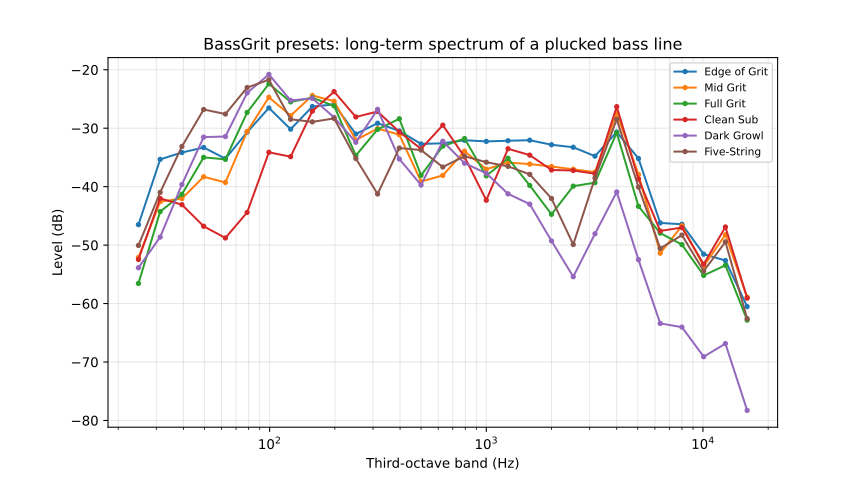
Data: presets_spectrum.csv (preset, band_hz, level_db) and presets_levels.csv (preset, loudness_rel_db, peak_dbfs, square_peak_dbfs).
Signal path
in → DC blocker (5 Hz)
   ├─ low band:  4th-order low-pass (Crossover) → delay 32 samples → × Low Blend ─────┐
   └─ high band: 4th-order high-pass (Crossover)                                      │
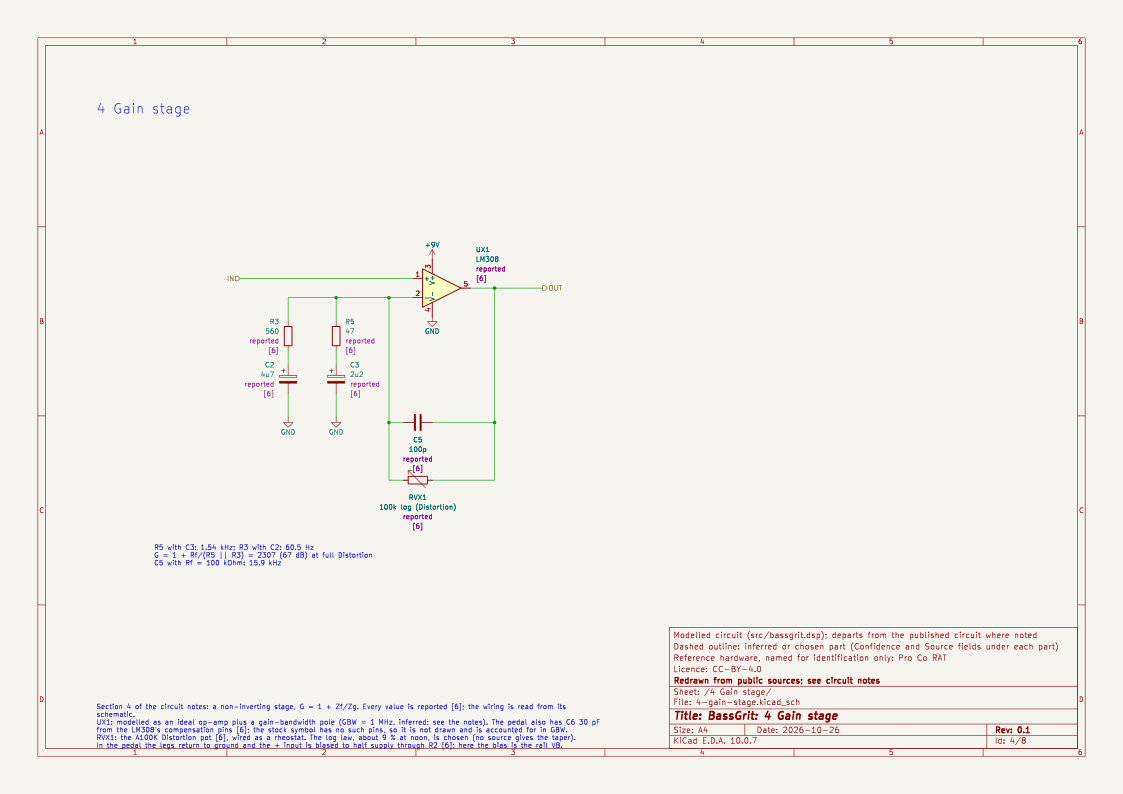
        → op-amp stage: input + branch (47 Ω/2.2 µF and 560 Ω/4.7 µF legs,           │
          feedback pole, gain-bandwidth pole)                                         │
        → 4x oversampled hard diode clip (0.6 V) → Filter low-pass ───────────────────┤
→ sum → × 1.2 → Level → safety limiter (≤ −0.1 dBFS) → out
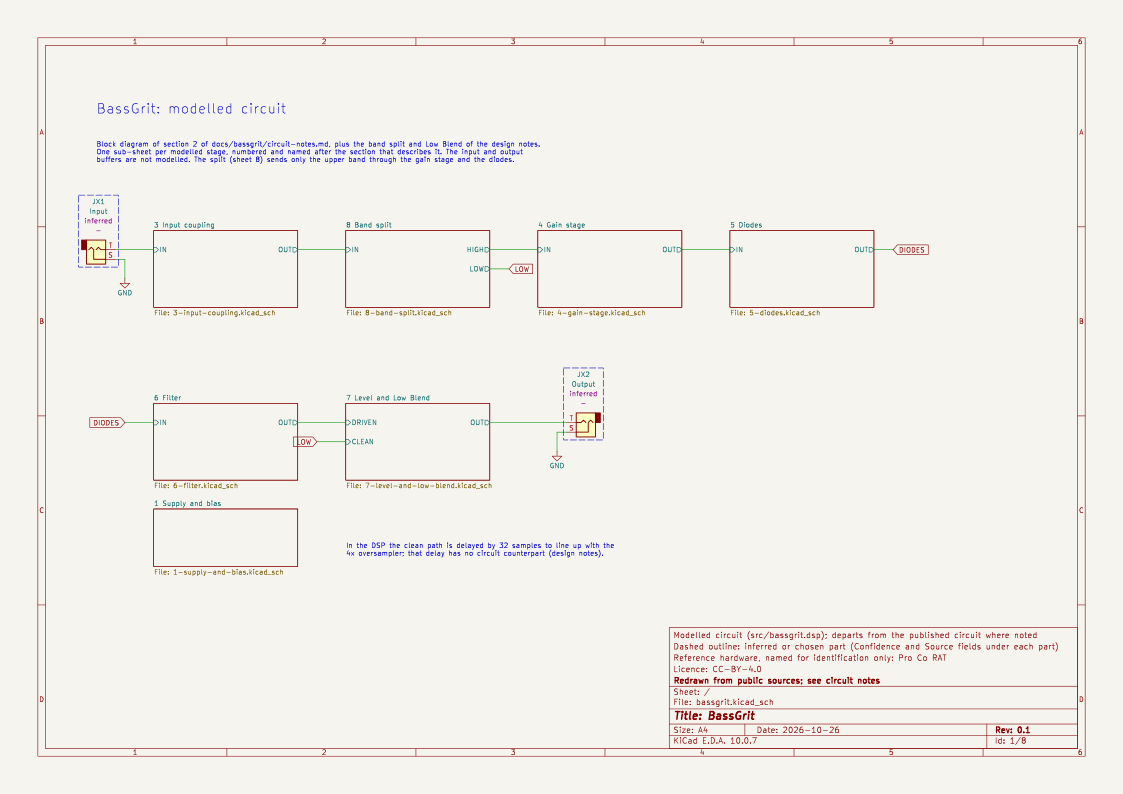
The schematic redraws this as analogue stages, one sheet per section of the circuit notes, plus the band split of the design notes. It draws the model: the DC blocker stands in for the pedal's input network, the Filter capacitor is 4.7 nF, and the band split and Low Blend are stand-ins with no circuit behind them. The root sheet:
The gain stage (sheet 4), where every value is reported from a public parts list and schematic:
Measured behaviour
These figures come from make test at 48 kHz. The plots below are regenerated each time the site is published. Click a plot to open it full size; the CSV data behind each one is linked underneath.
Summary
- Silence in gives silence out. The output stays below −120 dBFS at 16 combinations of extreme settings.
- Peak level. With 0 dBFS square waves, noise, sweeps or impulses in, at every Low Blend and Crossover tried, the worst sample is −0.10 dBFS.
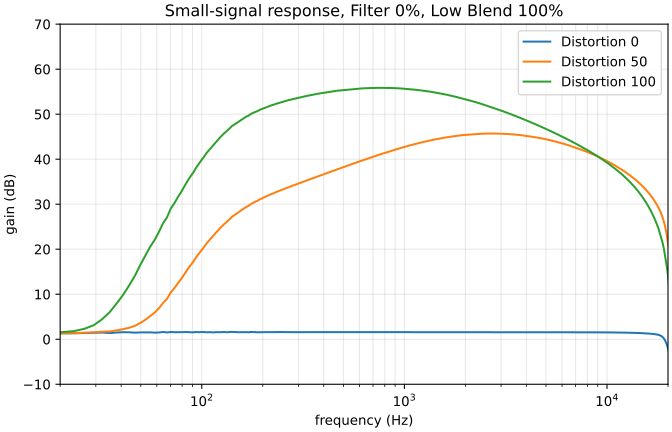
- Flat at Distortion 0. With Filter 0 and Low Blend 100 the response is within 0.21 dB of its 1.6 dB trim from 30 Hz to 8 kHz.
- Clean fundamental. At Distortion 50 the 41 Hz gain moves +0.7 dB while 1 kHz rises +41.1 dB. A 41 Hz tone at −12 dBFS has THD of −77.2 dB, against −11.6 dB with the Crossover at 40 Hz.
- Gain-bandwidth limit. At Distortion 100, 5 kHz is 8.9 dB below 1 kHz. At Distortion 50 it is 1.7 dB above.
- Odd-order distortion. The clipper is symmetric: even/odd −81.7 dB at 110 Hz and −89.8 dB at 220 Hz.
- Aliasing. Against a 1x build at Distortion 100, 4x oversampling lowers the worst alias by 42.5 dB at 221 Hz and 24.0 dB at 441 Hz, where it is −61.5 dBc. At 1.1 kHz it is −45.8 dBc and at 3.7 kHz −34.5 dBc: a near-square wave cannot be made alias-free by 4x oversampling.
Frequency response
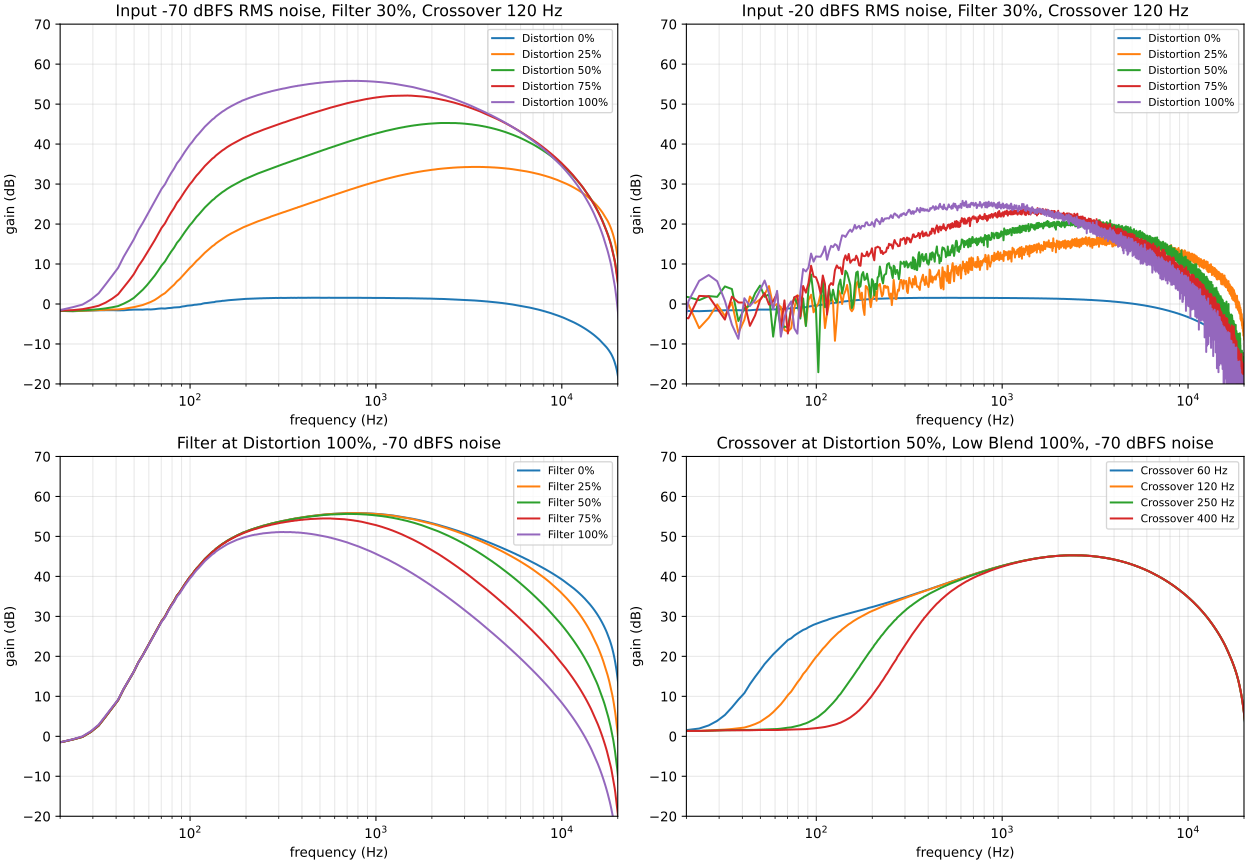
Data: freqresp.csv (columns panel, input_dbfs, setting, freq_hz, gain_db).
- Distortion (top left, −70 dBFS noise). The low end stays at about 0 dB and the gain hump rises and moves down in frequency, from a 1.6 dB plateau at Distortion 0 to a 55 dB peak near 800 Hz at Distortion 100. The top rolls off earlier at high settings (the gain-bandwidth pole).
- Louder input (top right, −20 dBFS). The diodes compress the hump to about 15 dB to 25 dB.
- Filter (bottom left). Only the top changes: the corner moves from above 20 kHz to about 330 Hz.
- Crossover (bottom right). The knee between the clean low band and the driven band moves from 60 Hz to 400 Hz.
Harmonics and aliasing
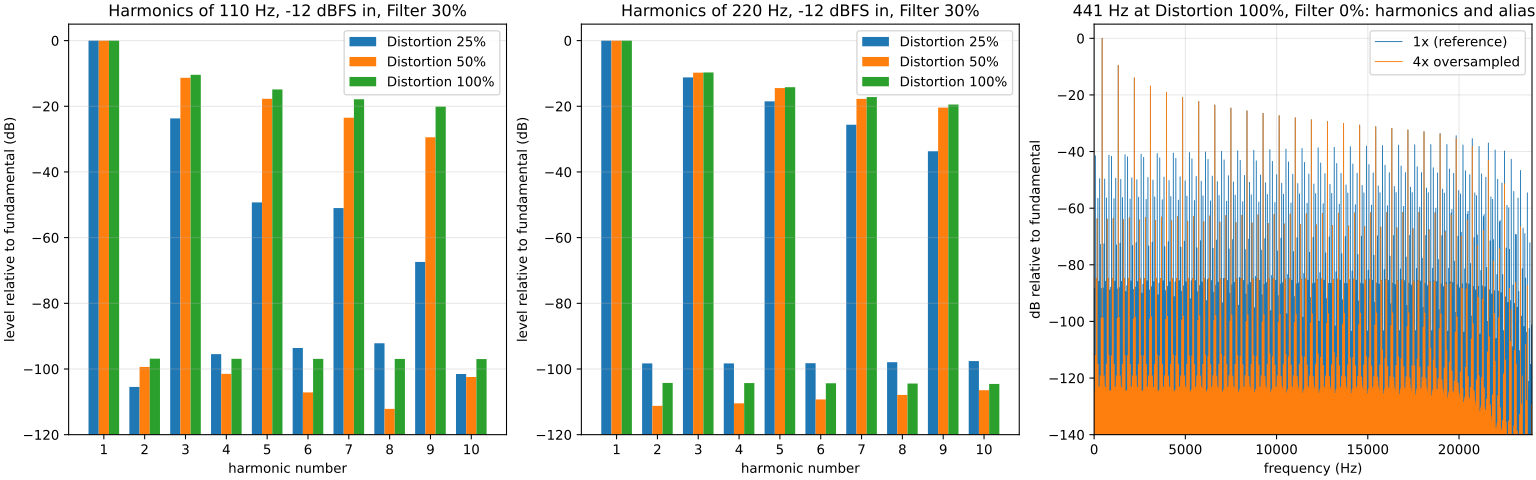
Data: harmonics.csv (f0_hz, distortion, harmonic, level_dbc) and aliasing.csv (build, f0_hz, worst_alias_dbc).
Only odd harmonics appear. At 110 Hz, H3 is −24 dBc at Distortion 25 and about −10 dBc at 100, and the higher odd harmonics fill in as Distortion rises.
Design targets
Data: targets.csv (quantity, value). The eight targets are listed with their measured values in section 5 of the design notes.
What to tune by ear
These values are chosen or inferred, and nothing has been listened to. The constants are in src/bassgrit.dsp.
- Crossover default (120 Hz), and its slope.
Cfilt(4.7 nF): the Filter range.Vd(0.6 V) andnKnee(4): the clipping level and hardness.- The Distortion law (
Rf): where in the travel the gain rises. GBW(1 MHz): how early the top rolls off at high Distortion.outTrim(1.2) and the input level convention: 0 dBFS is treated as 1 V at the input.
Known limitations
- Gain-bandwidth product is inferred. The component values and wiring are reported from a public parts list and schematic (source 6 of the circuit notes), but the LM308's GBW with its 30 pF compensation capacitor (
GBW, 1 MHz) is an order of magnitude only, and the ElectroSmash analysis could not be reached. - Not modelled: the pedal's 34 Hz coupling high-pass (C7 with R6) while the diodes conduct, the input buffer, and the LM308's rail and slew limits.
- The schematic draws the model, not the pedal. The band split and Low Blend have no circuit behind them, so they are standard analogue stand-ins, all chosen.
- Not a circuit simulation. The diodes are a static knee, and the op-amp's rail and slew limits are not modelled.
- Full Distortion is not alias-clean above about 500 Hz.
- At Distortion 100 the lowest octave is not fully clean: the clipper's gain from 60 Hz leaves a lift of only 3.4 dB from Low Blend at 30 to 60 Hz.
- Mono only.
BassGrit is an independent design built from public information. It is not affiliated with, or endorsed by, any pedal manufacturer.