BassEras
A bass preamp and DI built around one knob. Character re-voices the whole preamp at once: below noon it scoops the low mids for a deep, big-stack sound; at noon it is flat and warm; above noon it pushes the upper mids, adds gain, and lets hard notes push the second clipping stage off centre, so a note's body blooms with second harmonic just after the attack. Drive, Bite, a clean Blend, a three-band EQ and a speaker sim complete it.
It borrows its control set and signal chain from a bass preamp/DI pedal whose Character knob sweeps through amp voicings of several eras. That pedal's circuit is not public, so the stages are chosen. See the design notes for the idea and the circuit notes for what is borrowed.
Download
Download BassEras 0.1.0 Try it in your browser
Single formats: CLAP · VST3 · LV2
Linux x86_64. CLAP, VST3 and LV2 with an installer. SHA256SUMS · Release notes · How to install
Details
| Property | Value |
|---|---|
| Source | src/basseras.dsp |
| Plugin URI | urn:pedalkit/basseras |
| LV2 class | Amplifier |
| Channels | Mono in, mono out |
| Latency | 64 samples (1.33 ms at 48 kHz), reported to the host |
| Research | Circuit notes, design notes |
Controls
| Control | Range | Default | What it does |
|---|---|---|---|
| Level | −40 to +12 dB | 0 dB | Output level |
| Blend | 0 to 100 % | 100 % | 0 = clean only (the EQ and Level stay active), 100 = preamp only |
| Drive | 0 to 100 % | 30 % | Gain into the two clipping stages, 0 to 30 dB |
| Character | 0 to 100 % | 50 % | Pre-clip mid cut (−15 dB near 250 Hz) at 0, flat at 50, mid boost (+15 dB near 700 Hz) with up to 12 dB more gain and the bias bloom at 100 |
| Low | −12 to +12 dB | 0 dB | Shelf at 125 Hz |
| Mid | −12 to +12 dB | 0 dB | Band at 1 kHz |
| High | −12 to +12 dB | 0 dB | Shelf at 3.2 kHz |
| Bite | 0 to 100 % | 100 % | Subsonic high-pass before the clipping (10 Hz up to 40 Hz) and a presence peak after it (up to +6 dB at 2.5 kHz). Continuous, where the pedal has a switch |
| Cab Bypass | off / on | off | Removes the speaker sim from the preamp path, for a cabinet or an impulse response. Crossfaded, so it doesn't click |
Every control is smoothed. The plugin also has a read-only Latency output for the host. The LV2, VST3 and CLAP plugins ship with eight factory presets.
Presets
Each preset sets every control. Level is set so that a −12 dBFS plucked bass line (E1 to G2) comes out within 0.05 dB of "Studio Flip" (K-weighted), so switching presets doesn't jump in loudness. Bite is on and the speaker sim is in every preset.
| Preset | Level | Blend | Drive | Character | Low | Mid | High | Idea |
|---|---|---|---|---|---|---|---|---|
| Studio Flip | 0 | 100 | 30 | 50 | 0 | 0 | 0 | The defaults: warm, flat, light grit |
| Clean DI | 0 | 0 | 30 | 50 | 0 | 0 | 0 | Preamp bypassed; EQ and Level only |
| Seventies Stack | −4.2 | 100 | 45 | 20 | +3 | +2 | −2 | Deep and scooped in the low mids |
| Thumpy Funk | +2.9 | 80 | 15 | 35 | +4 | −3 | +3 | Hollow, percussive attack |
| Fat Tube | −7.4 | 100 | 55 | 60 | +2 | 0 | −3 | Thick, rounded breakup |
| Warm Compression | −4.0 | 70 | 60 | 40 | +1 | 0 | −2 | Clipping evens the level; clean keeps the attack |
| Modern Crunch | −8.8 | 100 | 60 | 80 | 0 | +2 | +2 | Pushed upper mids and the bloom |
| Fuzzed Out | −10.8 | 85 | 90 | 100 | +3 | −2 | 0 | Heavy, compressed distortion |
Levels and EQ are in dB, the rest in %. The names follow the kinds of sound the reference pedal's manual suggests, but the settings are chosen, not taken from it, and nobody has listened to them. They live in src/basseras.presets.toml.
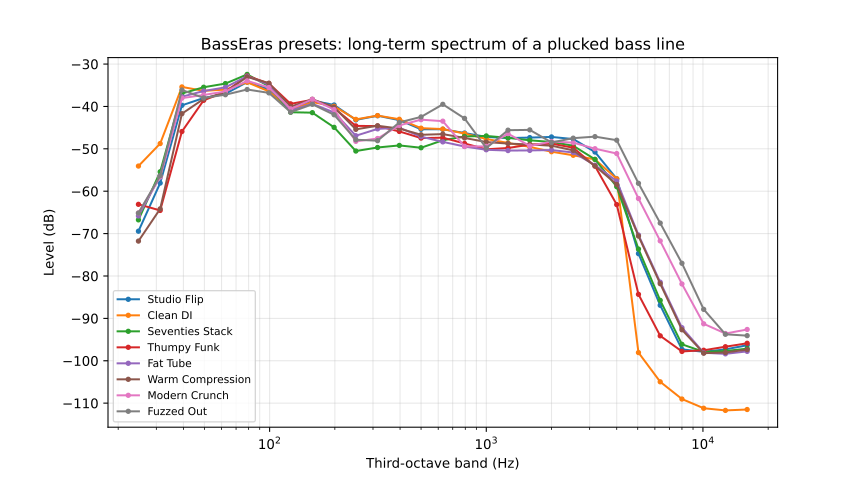
Data: presets_spectrum.csv (preset, band_hz, level_db) and presets_levels.csv (preset, loudness_rel_db, peak_dbfs, square_peak_dbfs).
Signal path
in → DC blocker (5 Hz)
   ├─ clean: delay 64 samples ───────────────────────────────────────────────┐
   └─ preamp: Bite subsonic high-pass (10 → 40 Hz)                            │
        → Character mid EQ (250 → 700 Hz, ±15 dB) → gain (Drive, + Character) │
        → 4x oversampled soft clip (±1.2 V) → 6 kHz low-pass                  Blend
        → ×4 → 4x oversampled rail clip (±3.1 V), biased by hard notes        │
        → DC blocker (5 Hz) → Bite presence (2.5 kHz)                         │
        → speaker sim (or Cab Bypass) → trim ─────────────────────────────────┘
→ Low (125 Hz) → Mid (1 kHz) → High (3.2 kHz) → Level → safety limiter (≤ −0.1 dBFS) → out
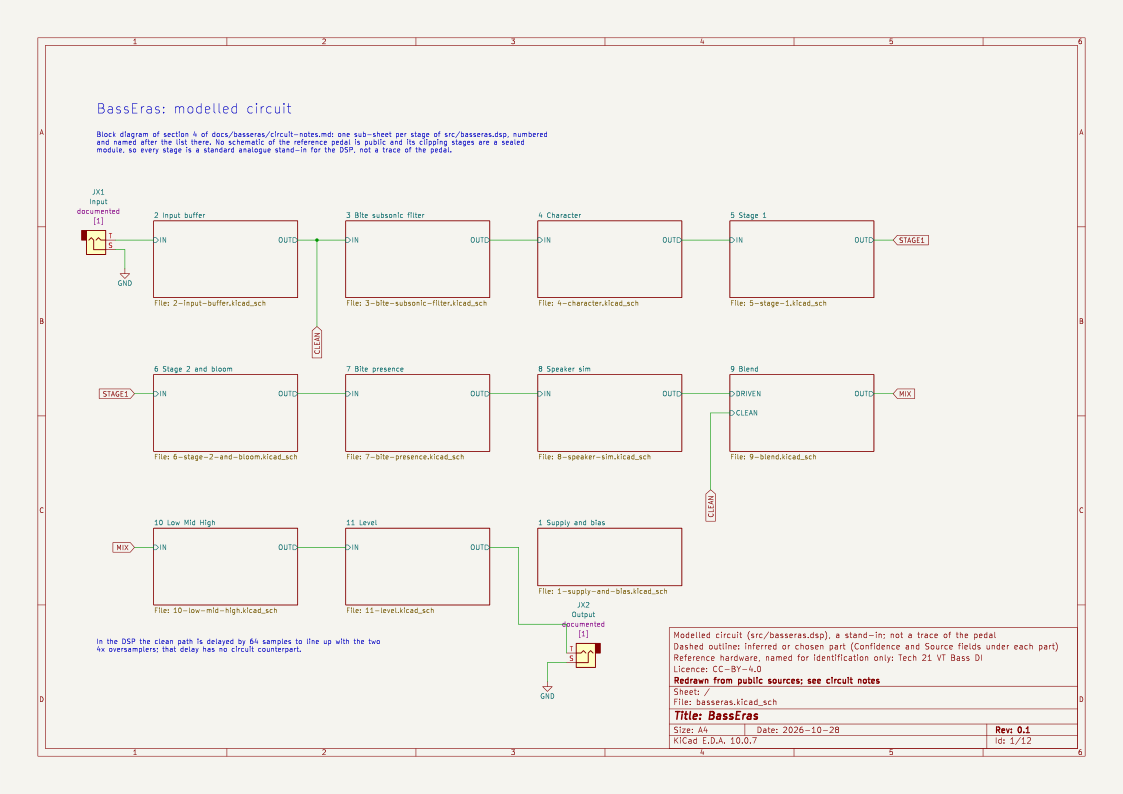
The schematic draws each stage as a standard analogue stand-in, one sheet per stage, listed in section 4 of the circuit notes. Nothing in it is a trace of the pedal. The root sheet:
Measured behaviour
These figures come from make test at 48 kHz. The plots below are regenerated each time the site is published. Click a plot to open it full size; the CSV data behind each one is linked underneath.
Summary
- Silence in gives silence out. Below −120 dBFS at 288 combinations of extreme settings.
- Peak level. With 0 dBFS square waves, noise, sweeps or impulses in and every control at maximum, the worst sample is −0.10 dBFS.
- Clean path. With Blend 0 and a flat EQ the response is within 0.09 dB from 30 Hz to 15 kHz.
- EQ. Mid reaches ±12.0 dB at 1 kHz. Low and High are ±5.9 dB at their corners and ±11.7 to 12.0 dB a factor of 3 beyond; cut mirrors boost.
- Character. The pre-clip EQ lands within 0.1 dB and 1 % of its design: −15.0 dB at 252 Hz (Character 0) to +15.0 dB at 697 Hz (Character 100). At Drive 30, THD rises from 0.8 % (Character 0) and 5.7 % (50) to 34.3 % (100).
- Bloom. At Character 100 a hard 110 Hz note carries second harmonic at −25.5 dBc (−84.2 dBc at Character 50). It builds over 33 ms, is still 25 dB above Character 50 100 ms after the note, and is gone (−80.8 dBc) 1.1 s later.
- Bite. −15.6 dB at 15 Hz, +6.0 dB at 2.5 kHz, within 0.27 dB from 100 to 500 Hz. At full Drive it lowers the intermodulation of a 15 Hz rumble with a note by 25 dB.
- Speaker sim. −3 dB at 3.72 kHz, −28 dB at 10 kHz, no peak (+0.07 dB). Cab Bypass is within 0.8 dB of the voiced loudness at every setting measured.
- Limiting. At Drive 100 the output rises 0.01 dB per dB from −20 to 0 dBFS in.
- Aliasing. At full Drive, Character and Bite, 4x oversampling lowers the worst alias by 49.7 dB at 441 Hz (to −89.9 dBc) and 21.5 dB at 1.1 kHz (to −52.2 dBc) against a 1x build.
- CPU. About 2.3 % of one core at 48 kHz at the defaults, 2.7 % with every control at maximum.
Frequency response
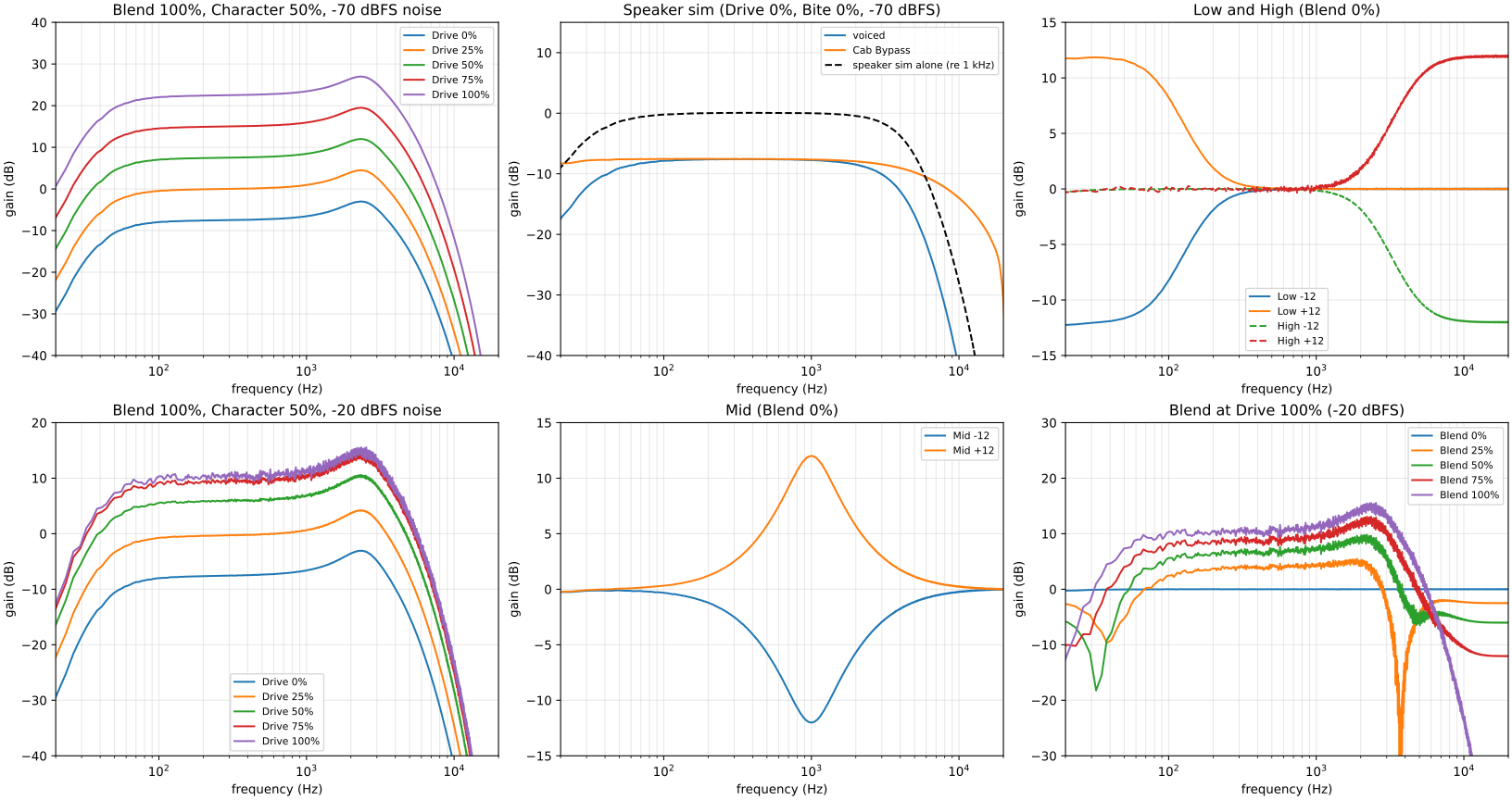
Data: freqresp.csv (panel, input_dbfs, blend, drive, character, low, mid, high, bite, cab_bypass, freq_hz, gain_db).
Character
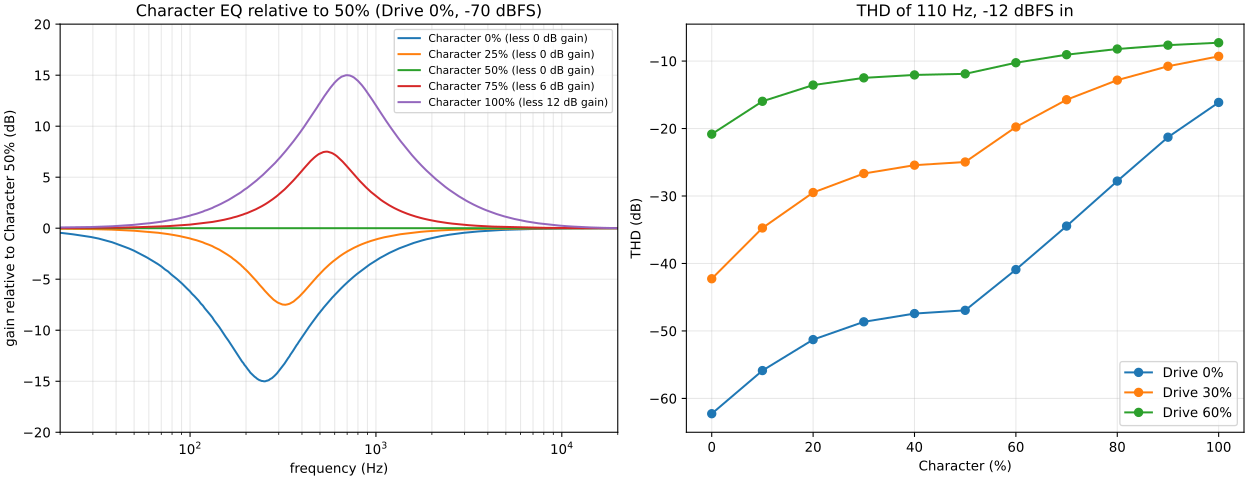
Data: character.csv (test, character, x, value_db).
Dynamics: the bloom
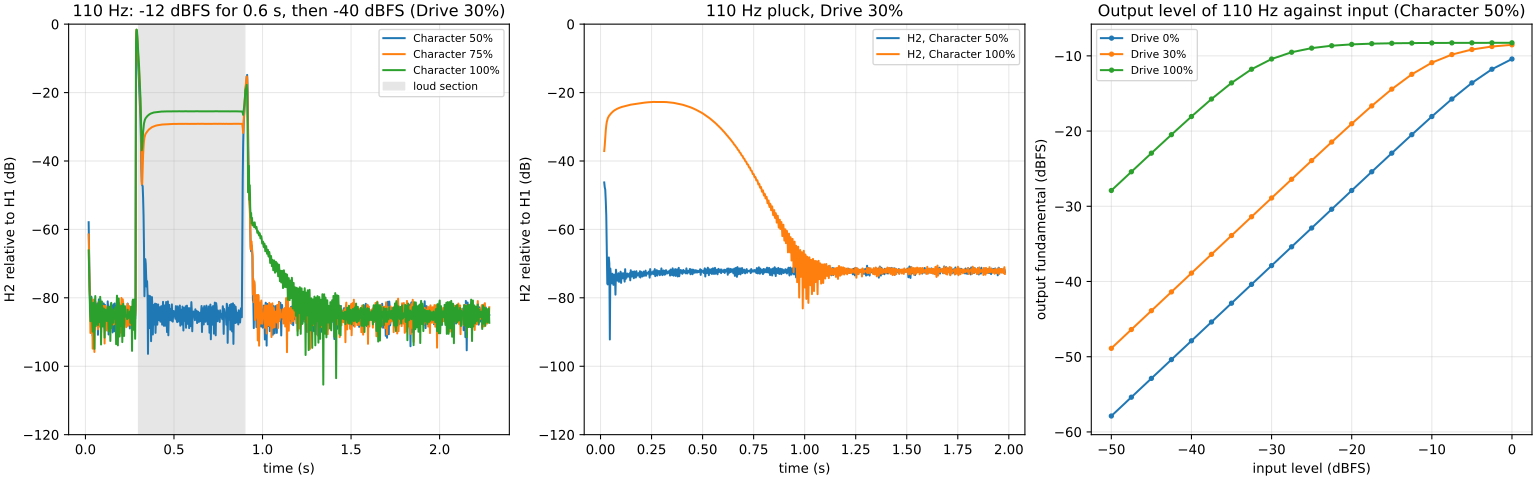
Data: dynamics.csv (test, setting, series, x, value_db).
Bite
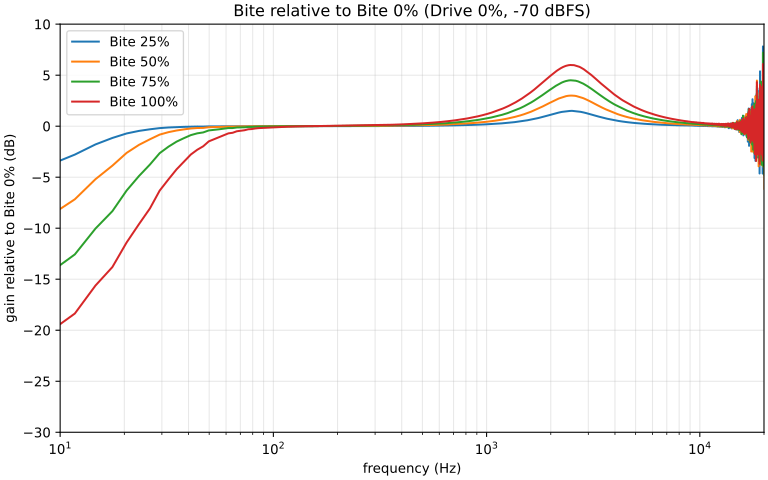
Data: bite.csv (bite, x, value_db).
Cab Bypass
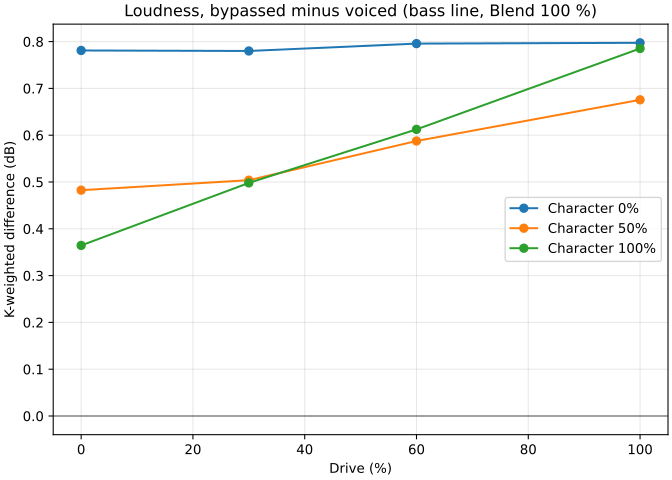
Data: cabsim.csv (character, drive, bypassed_minus_voiced_db).
Harmonics and aliasing
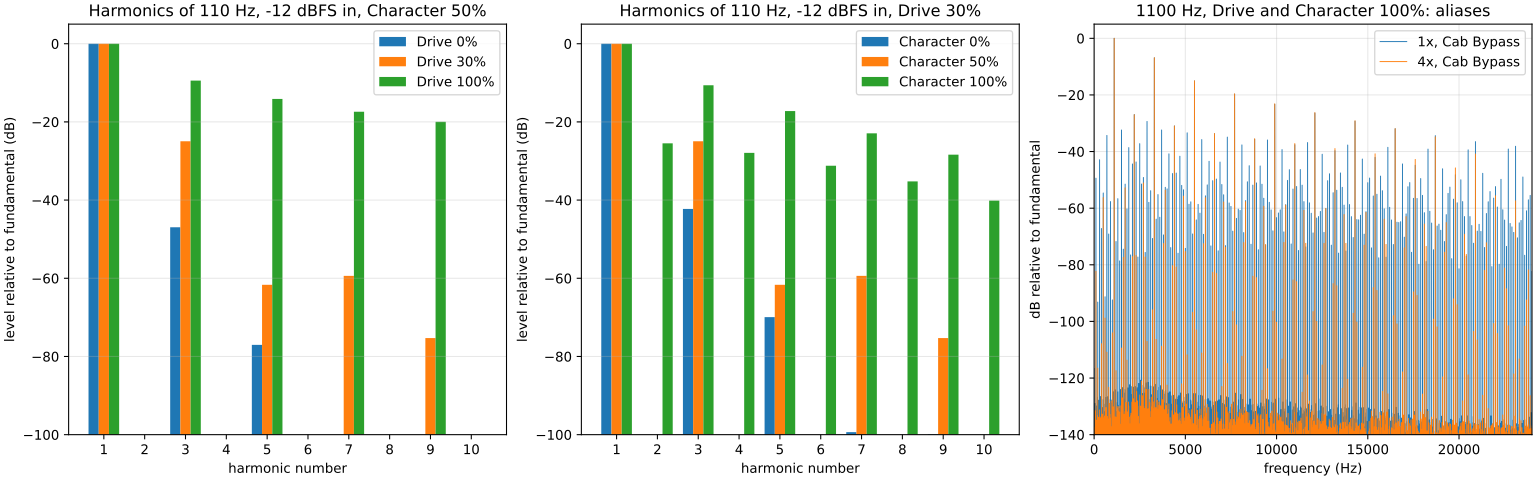
Data: harmonics.csv (f0_hz, drive, character, harmonic, level_dbc) and aliasing.csv (build, cab_bypass, f0_hz, worst_alias_dbc).
What to tune by ear
Nothing has been listened to. The constants are in src/basseras.dsp, and the design notes give the intent of each.
- The Character sweep: its direction, its ends (
charFLo250 Hz,charFHi700 Hz),charQ(0.7) andcharGainDb(12 dB). - The bloom:
bloomMax(0.25 ×railV),bloomAtt(20 ms) andbloomRel(150 ms). KeepbloomMaxat or below 0.25 ×railV, or a sudden Character jump clicks. - The speaker sim:
cabLp1F(4.5 kHz),cabLp2F(6 kHz) andcabHpF(30 Hz). - Bite:
biteHpHi(40 Hz),presF(2.5 kHz) andpresDb(+6 dB). - The clipping:
v1(±1.2 V),g2(4),railN(4),interLp(6 kHz) anddriveMaxDb(30 dB). drvTrim(0.42) and the default Drive (30 %).
Known limitations
- Not a model of the pedal. Its clipping stages are in a sealed module, and no schematic is public, so every stage is chosen. Only the control set, the EQ frequencies and range, and the order of the stages come from sources.
- The Character sweep is a guess. The direction of the cut and boost, and the moving centre, are not documented.
- The schematic is a stand-in. It draws the Character centre at noon only, and first-order shelves where the DSP has second-order ones.
- Not modelled: the pedal's XLR pad, +10 dB switch, parallel output, phantom power and ground lift.
- Mono only.
BassEras is an independent design built from public information. It is not affiliated with, or endorsed by, any pedal manufacturer.